
Line Array vs Point Source: Event Sound Systems Compared
By the Solutions Events team ·
The short answer: for rooms up to about 300 guests, a pair of good point-source speakers is enough. Beyond that, or in a long room or outdoors, a line array keeps every row at the same level. Column speakers are the secret weapon for clear speech in echoey halls. Subwoofers are for music, not speeches.
The main types of event speakers
| System | What it is | Strengths | Best for |
|---|---|---|---|
| Point-source speakers | A 12" or 15" speaker on a stand or flown, one or two per side | Simple, quick, affordable | Rooms up to about 300 guests, breakouts, receptions |
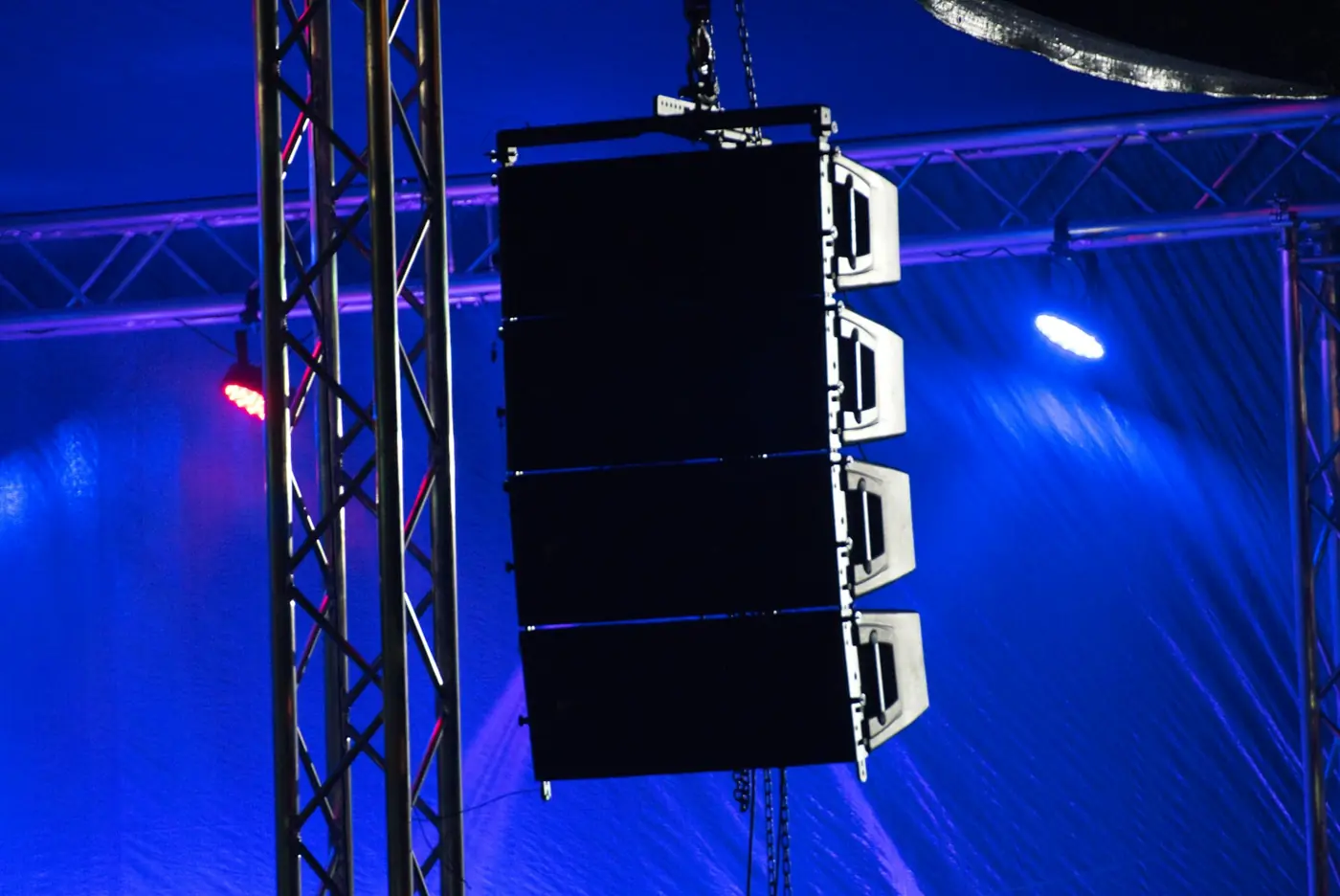
| Line array | A column of identical boxes hung in a curve | Even level from front to back, long throw, less spill on walls | Halls over 300 guests, long rooms, outdoor shows |
| Column array | A slim, tall speaker with many small drivers | Very clear speech in echoey rooms, discreet look | Conferences, places of worship, marble halls |
| Subwoofers | 15" or 18" speakers for the low end | Weight and punch for music | DJ nights, sangeet, concerts, launch films |
| Delay and fill speakers | Extra speakers further into the room, timed to the main system | The back and sides hear the same as the front | Long halls, lawns, areas behind pillars |
| Stage monitors and in-ear | Speakers or earpieces for the people on stage | Performers hear themselves | Bands, singers, panel discussions |
Line array vs point source
A point-source speaker spreads sound from one spot, and the level drops quickly with distance: the front row gets too much and the back row too little. A line array is a curved column of boxes that throws sound further and more evenly, and keeps it off the ceiling and walls. That is why concerts and large conferences use arrays, and why a pair of speakers on stands sounds fine at a reception but fails in a 600-seat hall.
Sound by guest count
| Guests | Speakers | Microphones | Mixer |
|---|---|---|---|
| Up to 100 | A pair of 12" speakers, one sub if there is music | 2 to 4 wireless | Small digital mixer |
| 100 to 300 | A pair of 15" speakers or a small array per side, 2 subs | 4 to 6 wireless and a podium mic | 16-channel digital |
| 300 to 700 | Line array, 4 to 8 boxes per side, 4 subs, front fills | 6 to 10 wireless, podium, lapels | 24 to 32-channel digital |
| 700 to 2,000 | Line array, 8 to 12 boxes per side, 6 to 8 subs, delays | 10+ wireless, in-ear for performers | 32+ channel digital, separate monitor mix |
| 2,000 and more, outdoors | Line array, 12+ boxes per side, 12+ subs, delay towers | Full band and stage kit | Front-of-house and monitor consoles |
This is a starting point. The shape of the room matters as much as the headcount: a long, narrow hall with a marble floor needs more care than a carpeted square ballroom. We confirm the design from the venue plan or a site visit.
Why "watts" is the wrong question
Many quotes are written in watts: "10,000-watt DJ system". Watts measure what the amplifier can draw, not how clear or even the sound will be. Ask for the speaker model, how many boxes per side, how many subwoofers, and whether an engineer will tune the system to the room. Those decide whether the last row can hear the speech.
Microphones
- Wireless handheld: anchors, questions from the floor, award winners.
- Podium (gooseneck): speeches and lecterns.
- Lapel or headset: presenters who walk, panel speakers, fashion and dance shows.
- Boundary and table mics: boardrooms and round tables.
Wireless channels must be coordinated so they do not drop out, and spares with fresh batteries should sit by the console.
Mixers: analogue or digital
A digital mixer stores scenes, so the settings for the keynote, the panel and the band can be recalled at a touch, and it can feed a clean mix to cameras and live streams. Analogue mixers still work for simple set-ups, but most events now use digital.
Sound for weddings, DJ nights and concerts
For a wedding, the speeches and the ceremony need clarity and the dance floor needs subwoofers, often in different areas. For a sangeet or DJ night, place the subwoofers near the dance floor and keep the dining area at a lower level. For an open-air concert, plan delay towers so the back of the crowd hears the band in time with the stage.
What we use
Our own stock includes JBL VRX line arrays, JBL EON powered speakers, Shure and AKG wireless microphones and digital consoles, with an engineer included on every hire. See sound system rental in Kolkata, our inventory, and the conference AV checklist.
Common questions
What sound system do I need for 500 people?
For 500 guests indoors, a line array of 4 to 8 boxes per side with 4 subwoofers and front fills, 6 to 10 wireless microphones and a 24 to 32-channel digital mixer, with an engineer at the console.
Line array or point source: which is better?
Point-source speakers are simpler and fine for rooms up to about 300 guests. A line array keeps the level even from the front row to the back, so it is better for large halls, long rooms and outdoor shows.
How many watts do I need for my event?
Watts say little on their own. Ask instead for the speaker model, the number of boxes per side and the number of subwoofers, and whether an engineer will tune the system to the room.
Which microphones are best for a conference?
Wireless handhelds for questions, a podium microphone for speeches, and lapel or headset microphones for presenters who walk. Always keep spares and fresh batteries.