Exhibition Stall Fabrication: From Brief to Build
By the Solutions Events team ·
A stall has a few seconds to stop someone walking down an aisle. Good fabrication is what makes the design on paper look the same on the show floor. Here is how the process works and what to decide at each stage.
Start with the space
- Shell scheme. The organiser provides a standard Octonorm booth, typically 2 × 3 m or 3 × 3 m, with a fascia name, a table, chairs, spotlights and a plug point. You brand the panels. Quick and economical.
- Raw or bare space. You get only the floor area and build a custom stall. More impact, more planning.
Before any design starts, get the floor plan from the organiser: the stall number, which sides are open, the height limit and the location of power points and pillars.
The brief
A useful brief answers five questions:
- What is the one product or message a visitor should remember?
- What needs to be displayed, and what are its size and weight?
- Do you need a meeting area, a store room or a demo counter?
- Will there be screens, an LED wall or live demonstrations that need power?
- What is the budget range?
Design and approval
Ask for a 3D design with dimensions, not only a mood board. Check the branding height against the organiser’s limit, the visibility from each open side and the walking space inside. Approve the artwork files at full size before printing.
Materials
- Octonorm system. Aluminium frame with panels. Fast, reusable and clean.
- Wood and plywood. For custom shapes, counters and a finished look.
- Flex and vinyl prints. For large graphics, mounted on a masked plywood frame for a flat finish.
- 3D letters and logos. For the fascia and the photo point.
- Lighting, carpet and screens. These decide how finished the stall feels.
A realistic timeline
- Four weeks before: brief and floor plan.
- Three weeks before: 3D design and revisions.
- Two weeks before: approval, artwork and start of fabrication in the workshop.
- Build days: installation at the venue in the slot the organiser gives. This is often only one or two days.
- After the show: dismantling within the organiser’s deadline.
Most of the work should be finished in the workshop. Stalls that are built from scratch at the venue are the ones still being painted when the doors open.
Whole halls and pavilions
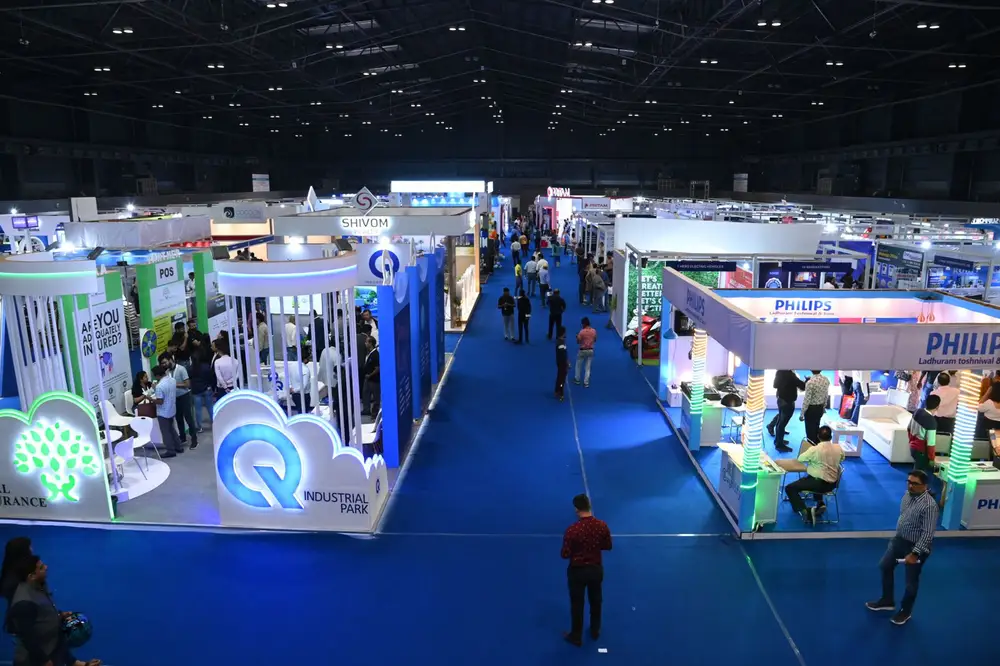
Organisers need the same discipline at a larger scale. For COKUSS 2022 we laid out, fabricated, signed and lit a hall of 210 stalls and kept a maintenance crew on site every morning of the nine-day run. For the Bengal Global Trade Expo 2022 we built four halls and a water-wall entrance.
We fabricate in our own workshop in Kolkata. See our trade show and fabrication work, or send the floor plan and your brief for a design and a quote.